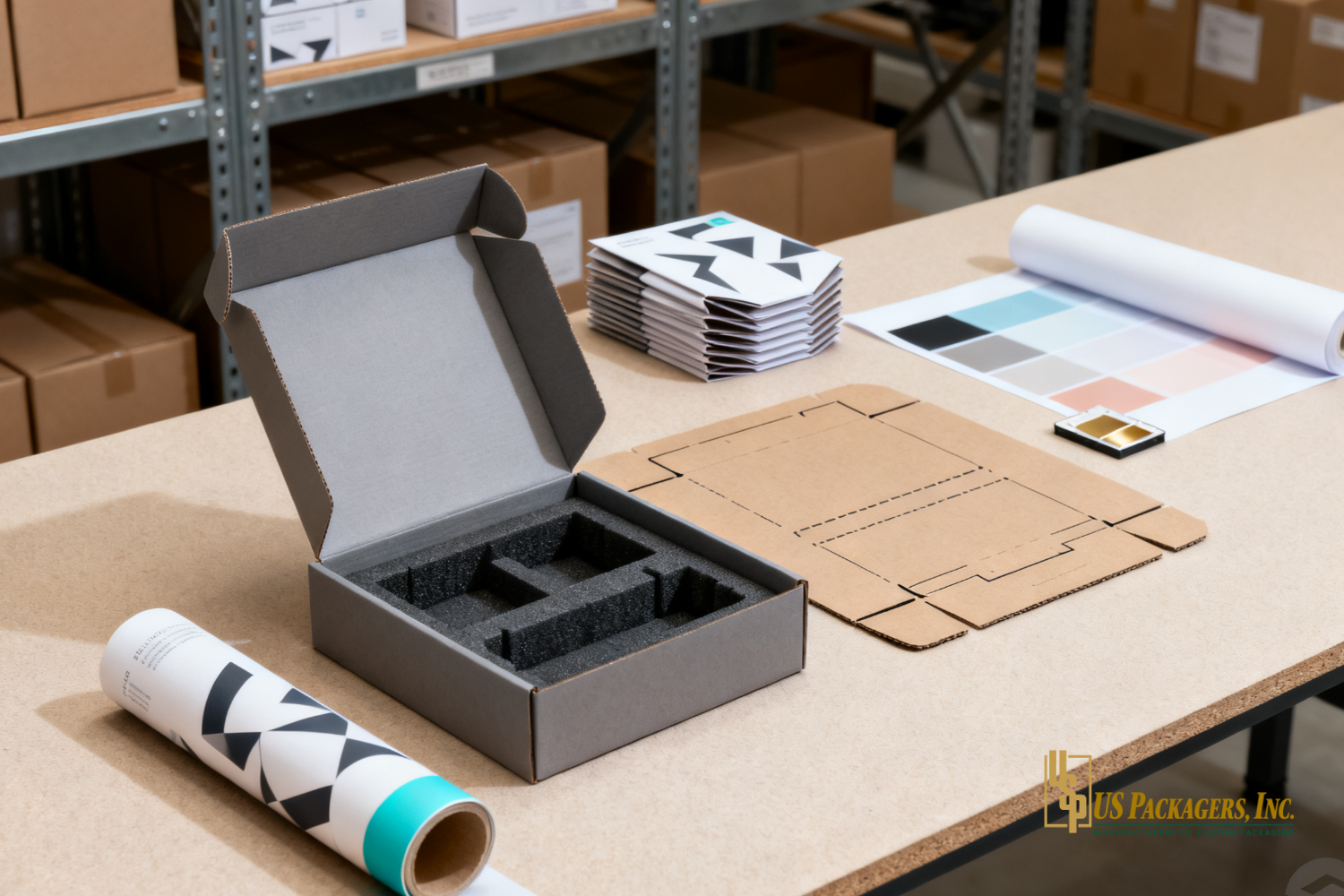
Entertainment packaging: design for impact and protection
Packaging often gets treated as an afterthought, yet it shapes first impressions and unboxing moments. Effective entertainment packaging combines visual storytelling with practical protection, letting products stand out at retail, live events, and direct-to-consumer deliveries while supporting promotional goals through Promotional Packaging.
Many teams struggle because entertainment packaging must satisfy marketing, protect often fragile components, meet transport requirements, and remain feasible within production budgets. Misalignment between branding, materials selection, manufacturing capacity, and fulfillment planning creates delays and extra cost.
Approach packaging choices as decisions about the full customer journey rather than only a container. US Packagers pairs in-house design with manufacturing to shorten feedback loops and keep brand intent aligned with production realities. Thoughtful collaboration up front produces memorable entertainment packaging and predictable outcomes.
Quick Answer
Effective entertainment packaging tells a clear brand story while protecting the product, simplifying logistics, and creating a memorable unboxing experience. It balances creative finishes and structural engineering, and benefits from early coordination between marketing, operations, and the packaging manufacturer.
Key Takeaways
Start with the customer moment to guide visual and functional decisions for entertainment packaging.
Prioritize protection for fragile or multi-part products to avoid damage at events and during shipping.
Choose materials and finishes that reflect the brand and are compatible with expected production volumes.
Evaluate custom packaging versus stock solutions based on branding needs, quantities, and budget.
Collaborate early with a manufacturer to align design, tooling needs, and fulfillment constraints.
Quick Business Snapshot
Category | Details |
|---|---|
Best For | Consumer brands, promotional products, event merch, and retail entertainment items |
Business Size | Small to mid-market brands and growing companies planning seasonal or event-driven runs |
Primary Benefit | Stronger brand impact and reliable product protection for events and retail |
Implementation Complexity | Moderate: requires coordination across design, production, and logistics |
US Packagers Service Fit | |
Typical Environment | Warehousing, event distribution, retail shelving, direct-to-consumer fulfillment |
Who Should Consider This Solution
Brands launching limited-edition entertainment products or event-specific merchandise that require standout packaging.
Marketing teams planning promotional giveaways or box sets for concerts, festivals, or fan events.
Food and beverage brands producing themed gift packs tied to entertainment properties.
Health and beauty lines releasing collector or limited-run packaging for collaborations with media or artists.
Operations teams that need packaging designed to survive complex shipping and event logistics.
What effective entertainment packaging delivers
Effective entertainment packaging tells the brand story, protects the product, and creates a memorable unboxing moment. That combination drives repeat engagement and increases perceived value at the point of sale or during event distribution. From a business perspective, packaging must meet multiple objectives: marketing impact, material cost, manufacturability, and transport resilience. Begin by specifying which of those objectives is primary. If brand exposure is the goal, invest in visual finishes and custom dielines. If logistics dominate, prioritize structural strength and nesting efficiency to reduce freight costs.
The manufacturing approach follows the business decision: for high-impact, low-quantity campaigns, custom printed folding cartons, rigid boxes, or die-cut mailers work well. For ongoing retail SKUs, consider scalable print processes and standardized inner supports to keep unit costs predictable. Work with a manufacturer early to test prototypes and adjust materials for real-world handling, especially for items that will be unboxed on camera or at live events.
Balancing brand impact and product protection
Prioritize brand impact while ensuring the packaging protects the product during event distribution and retail handling. Visual elements such as embossing, spot UV, or custom color work draw attention, but they should not compromise the box's ability to cradle delicate components. Choices about internal supports matter as much as exterior finishes. For multi-piece kits, design buffered compartments and consider removable inserts that secure each item while enhancing the unboxing sequence. Packaging that looks premium but fails in transit creates returns and damages reputation.
Calculate expected handling scenarios: hand-distributed promos, bulk shipping to venues, or direct-to-consumer parcels each impose different stressors. Select board grades, corrugation flute profiles, and internal supports that match those stressors, and validate with simple drop and inversion tests. Collaborate with production to choose print methods that maintain color fidelity at the target volume. When promotional runs are short, digital or short-run litho printing can produce high-quality finishes with reasonable lead times. For ongoing SKUs, traditional offset print with consistent color management yields lower per-unit cost at scale.
Materials, finishes, and print choices that make sense
Choose materials and finishes based on the product, audience expectations, and budget, not on trends alone. Paperboard and folding cartons offer design flexibility and are suitable for lightweight merch, while rigid boxes deliver a premium feel for collector editions. Corrugated options work for bulk shipping and merch bundles. Finishes like matte lamination, soft-touch coatings, and selective varnish enhance perceived quality, but they add cost and may require production proofing. For vibrant graphics, use high-resolution printing and work with the manufacturer on color profiles to match brand standards.
Consider sustainable material options early—recyclable uncoated stocks or recycled content can align with brand values without sacrificing appearance. Also evaluate secondary components such as foam inserts, die-cut trays, or magnetic closures; each adds to the unboxing experience but increases complexity and cost. Discuss tolerances and tooling needs with production to confirm compatibility with chosen materials and finishes before signing off on tooling or bulk runs.
Production scale and supply chain considerations
Plan production based on realistic demand forecasts and distribution channels to avoid overproduction or stockouts. Small, high-impact runs require different tooling and print strategies than long-term retail SKUs. If runs are limited, short-run digital printing reduces upfront costs and supports rapid iteration. For larger volumes, offset or flexographic printing becomes more cost efficient, but it demands longer lead times and upfront plate or tooling costs. Consider warehousing and kitting needs for event distribution and coordinate lead times with event schedules.
Factor in seasonal demand spikes, and build buffer stock if shipping to multiple venues. Work with suppliers to understand minimum order quantities, material availability, and seasonal pricing fluctuations. In-house manufacturing collaboration helps shorten feedback loops for prototypes, enabling faster adjustments to dielines, insert fits, and print proofs. Determine whether packaging will ship assembled with product or require on-site kitting; that decision affects labor planning, protective materials, and shipping cube calculations.
A Practical Example
A mid-size brand plans a limited-edition box set for a music festival and needs packaging that attracts attention, protects vinyl and merch, and ships in bulk to a venue. The challenge is combining a premium look with efficient shipping and on-site distribution. Decisions include choosing between a rigid box with foam inserts for premium perception or a reinforced folding carton with custom die-cut supports for lower weight and cost. The selected approach should reflect expected volume and the unboxing moment at the festival.
Using Custom Packaging capabilities allows early prototyping to validate structural design and print finishes. Prototyping helps confirm the insert layout, closure strength, and visual presentation under event lighting. Aligning manufacturing and logistics planning at the start simplifies shipping into venue storage and helps marketing plan the on-site reveal without last-minute packaging changes.
Labeling, shipping, and compliance considerations
Address labeling and shipping rules before finalizing the package to avoid delays at venues or distribution centers. Determine whether the product requires special labels for content, barcodes for retail, or international shipping marks. For food and beverage tie-ins, ensure packaging supports required ingredient listings and handling instructions. For domestic event distribution, prepare clear outer carton labeling for rapid scanning and inventory control.
Consider how retail POS codes or UPCs will be applied and whether prelabeling or sticker application during kitting is necessary. Coordinate with the manufacturer on print placement to avoid interfering with barcode readability or regulatory text. Incorporate cushioning or moisture-barrier solutions when items are sensitive to humidity. Planning these details early reduces rework and keeps final production aligned with logistical and compliance requirements.
Option | Custom Packaging | Stock Packaging |
|---|---|---|
Design Flexibility | High: tailored dielines, finishes, and inserts | Limited: standard sizes and finishes |
Unit Cost at Low Volume | Higher per unit due to tooling and setup | Lower per unit with minimal setup |
Brand Impact | Stronger: unique unboxing and bespoke branding | Moderate: relies on added labels or sleeves |
Practical Checklist
Define the customer moment: retail shelf, event unboxing, or DTC delivery.
Set protection requirements: fragility, multipart kits, or temperature sensitivity.
Choose material and finish options aligned with brand expectations and budget.
Decide between custom tooling or stock formats based on volume and impact needs.
Prototype and test fit, drop, and presentation before final production approval.
Confirm labeling, barcode placement, and any regulatory text required for the product.
Plan warehousing and kitting operations if packaging will be assembled or filled later.
What US Packagers Recommends
Evaluate branding and protection priorities first, then select materials and a manufacturing approach that match those priorities. For limited editions or event-focused runs, invest in custom dielines and finishes to create an iconic unboxing experience; validate with prototypes to confirm fit and handling. For recurring retail SKUs, focus on scalable print processes and robust internal supports to protect goods during multi-channel distribution. Coordinate design, operations, and marketing early to balance appearance, cost, and manufacturability. Use in-house design and manufacturing collaboration to reduce iterations and ensure the final packaging performs in real-world shipping and event conditions.
Common Mistakes to Avoid
Overemphasizing finish at the expense of structural integrity; avoid finishes that mask poor internal protection.
Delaying manufacturer input until after design finalization, which can cause costly rework.
Choosing a premium format without matching the target distribution channel, increasing damage risk.
Ignoring barcode placement and labeling requirements, which complicates retail and inventory workflows.
Underestimating kitting labor or warehousing needs for event distribution, causing delays onsite.
Frequently Asked Questions
What defines entertainment packaging compared with standard retail packaging?
Entertainment packaging emphasizes storytelling and experiential presentation while still meeting protection and logistical needs. It is often designed for high-impact reveal moments, limited editions, or event distribution and therefore integrates visual finishes and unique structural choices to create a memorable customer interaction without compromising transit durability.
How early should production partners be involved?
Production partners should be consulted during concept development to align brand goals with manufacturability. Early collaboration reduces tooling surprises, helps choose appropriate materials, and ensures finishes are feasible at the planned production volume. Prototyping with the manufacturer verifies fit and function before full production.
Are sustainable materials practical for entertainment packaging?
Sustainable materials can be practical and effective when selected to match product protection needs. Recycled content boards, recyclable liners, and minimal plastic use can support brand values. Confirm with the manufacturer how chosen materials affect print quality, finishing options, and protective performance for event handling.
When is custom packaging worth the cost?
Custom packaging is worthwhile when branding, unboxing experience, or product protection cannot be met with stock formats. It is particularly valuable for limited runs, collector editions, or promotions where the packaging itself contributes to perceived value and brand storytelling.
How to manage packaging for multi-channel distribution?
Design packaging with the most demanding channel in mind, typically shipping or retail handling. Use inserts or modular designs that enable a single primary package to work for retail display and e-commerce. Plan outer cartons and palletization to protect inner packages during bulk shipping to venues or distribution centers.
Final thoughts on entertainment packaging
Entertainment packaging succeeds when it aligns brand storytelling with practical protection and logistical planning. Investing time in cross-functional collaboration, early prototyping, and realistic volume planning will deliver packaging that delights audiences and performs in the supply chain.
Why Trust US Packagers
Founded | 2012 |
Industry Experience | 40+ years of packaging industry experience |
Capabilities | In-house design and manufacturing; custom packaging expertise |
Philosophy | Customer-first packaging approach |
Services | Custom packaging, promotional packaging, product packaging |
Industries Served | Promotional products, entertainment, health and beauty, food and beverage |
Planning Your Next Entertainment Packaging Project
Packaging decisions should start with product, brand, and customer experience requirements and then move through materials, protection, and manufacturing considerations to achieve reliable results. Early collaboration helps determine whether custom tooling, prototype iterations, or a stock-based approach best meets campaign goals and budget, and it reduces risk during production. Create Promotional Packaging This collaborative process produces packaging aligned with product, brand, customer experience, shipping requirements, and manufacturing constraints before choosing a final solution.
