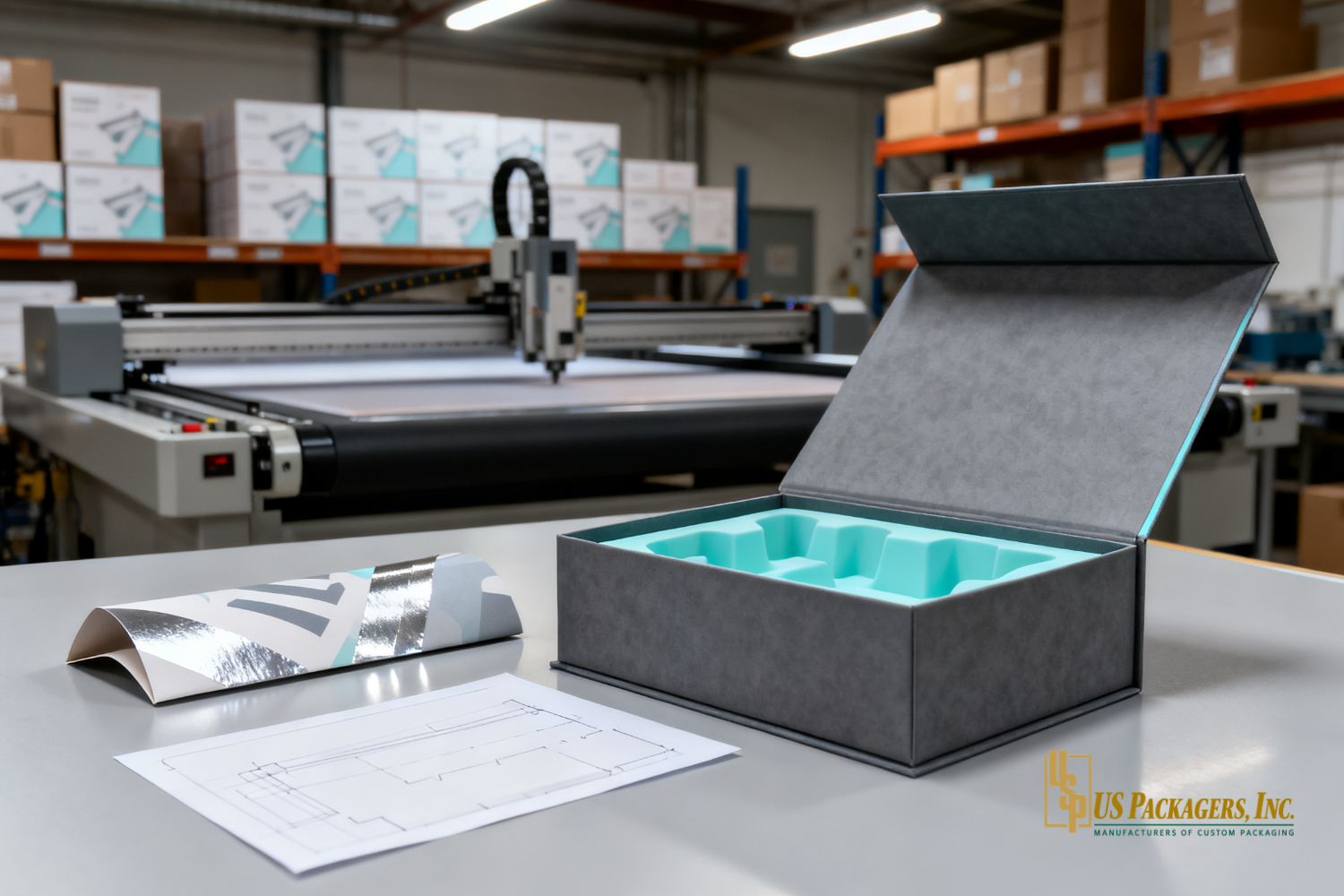
Designing the unboxing experience to lift brand value
Packaging often becomes the first meaningful contact between a brand and a customer, and that first contact shapes perceptions immediately. The unboxing experience matters because it translates packaging decisions into emotional response, perceived value, and repeat purchase intent. Premium packaging and thoughtful branded packaging turn a simple opening into a memorable customer experience that supports Luxury Packaging goals.
Packaging must do several jobs at once: protect product, represent the brand, survive shipping, and fit production constraints. Balancing those priorities requires coordination between marketing, operations, and manufacturing teams so the unboxing experience does not compromise protection or scalability.
Practical packaging advice starts with the customer and the product. US Packagers focuses on in-house design and manufacturing to align branded packaging with operational realities. Prioritizing clarity around audience expectations leads to packaging that protects product and builds brand equity over time.
Quick Answer
The unboxing experience matters because it converts functional packaging into emotional value. Good unboxing increases perceived product quality, supports brand storytelling, and can reduce returns when protection and presentation are aligned. Luxury Packaging that considers materials, structure, and finishing creates consistent customer experiences across channels.
Key Takeaways
Design packaging around the customer moment of opening, not only transport requirements.
Use branded packaging elements selectively to reinforce value without adding unnecessary cost or waste.
Match structural protection to shipping and handling risks to avoid returns and negative experiences.
Prototype and test unboxing flow before full production to identify friction points and visual opportunities.
Coordinate design, print, and production early to keep brand details consistent and manufacturable in-house.
Quick Business Snapshot
Category | Details |
|---|---|
Best For | Brands seeking elevated customer experiences |
Business Size | Small to mid-size and growing brands |
Primary Benefit | Higher perceived value and brand consistency |
Implementation Complexity | Moderate — design, prototyping, and alignment with fulfillment |
US Packagers Service Fit | Luxury Packaging |
Typical Environment | Direct-to-consumer, retail, and subscription fulfillment |
Who Should Consider This Solution
Consumer brands launching premium SKUs or limited editions that need a memorable reveal.
Health and beauty companies where presentation influences perceived efficacy and gifting appeal.
Food and beverage brands offering curated tasting kits or gift packaging requiring both protection and flair.
Promotional product providers and entertainment merchandise teams building brand loyalty through presentation.
Operations teams aiming to reduce returns by combining protection with clear unboxing instructions.
How the unboxing experience affects customer perception
The unboxing experience directly influences a buyer’s perception of product quality and brand credibility. When packaging opens smoothly, displays thoughtful layout, and presents product securely, customers infer attention to detail that often translates to trust. Conversely, packaging that is difficult to open, damaged on arrival, or visually inconsistent diminishes perceived value and can generate negative social media impressions.
From a business perspective, this matters because higher perceived value can support premium pricing and repeat purchases. Structurally, achieve this by prioritizing protective engineering for transit stresses, selecting tactile materials and finishes that fit the brand voice, and controlling print quality to maintain color fidelity. Design the unboxing sequence so key brand elements and product features are revealed in an intended order. Prototyping allows assessment of both the sensory moment and the protection performance under realistic shipping tests. Collaboration between designers and manufacturing ensures the chosen finishes and adhesives are feasible for in-house production and maintain consistency across runs.
Balancing brand, protection, and cost in premium packaging
The direct answer is that tradeoffs must be mapped against business objectives: brand uplift, damage rates, and cost per unit. Some brands prioritize visual impact and will accept higher unit costs for specialized materials and finishes. Others will prioritize protection and scalable manufacturing to support larger distribution footprints.
Assessing these tradeoffs begins with demand forecasting and a simple cost-benefit view of damage reduction versus material and labor costs. Structural inserts, compartmentalization, and protective liners reduce returns but add complexity. Printed graphics and soft-touch coatings increase brand impact but influence run sizes and lead to additional setup considerations. In-house manufacturing reduces coordination overhead and enables tighter quality control when balancing subtle brand cues with consistent protection. Selecting standard dielines and modular inserts where possible keeps complexity manageable while preserving premium visual elements, and spot-testing a smaller production run helps validate whether the perceived brand uplift justifies incremental cost.
Materials, finishes, and structural choices that shape the unboxing experience
The practical answer is to choose materials and finishes that align with brand tone and functional needs. High-end rigid boxes convey solidity and ceremony, while well-engineered folding cartons can create an elegant reveal at lower cost. Structural decisions determine how the product is presented and how secure it remains during transit.
For premium packaging, consider boards with higher caliper for rigidity, internal compartments for product positioning, and soft-touch or textured finishes for tactile impact. Embossing, foil, and spot varnish can highlight logos and focal points without overwhelming the design, but each finish adds production steps and cost. Protective choices such as molded pulp, foam inserts, or custom-cut corrugated trays depend on fragility and weight. Work with designers to balance visible brand moments with concealed protective solutions. When sustainability matters to customers, choose recyclable or compostable liners and clearly communicate those choices on the pack to support the experience rather than detract from it.
Operational considerations: fulfillment, shipping, and sustainability
The unboxing design must fit fulfillment workflows and shipping realities. Packaging that elevates experience but creates bottlenecks in packing or increases dimensional weight costs can erode margins quickly.
Operational planning includes assessing packing time per unit, compatibility with automated cells or manual packing stations, and the impact of package dimensions on carrier rates. Test the chosen packaging through actual packing runs to identify ergonomic issues or damage vectors. For subscription and repeat shipments, durability through multiple handlings matters. Sustainable choices can reduce material weight and waste but must still protect product effectively. Track return reasons tied to packaging to understand whether issues are visual, functional, or related to transit. Aligning design with real-world fulfillment constraints prevents expensive rework and preserves the desired unboxing effect for the customer.
A Practical Example
Scenario: a mid-size beauty brand launching a luxury skincare line needs packaging that feels premium, protects fragile glass bottles during ground shipping, and fits a subscription box format. The challenge is balancing a high-end reveal with cost and pack efficiency.
Decision points include selecting a rigid two-piece box for ceremony or a rigid-style folding carton to reduce cost. Protective inserts must prevent bottle-to-bottle contact and distribute forces encountered in carrier drop tests. The chosen US Packagers Service, Luxury Packaging, supports prototyping of rigid and folding options, testing protective inserts, and validating finishes such as soft-touch lamination and spot foiling. Early physical prototypes reveal how the product sits in the pack and whether the reveal sequence conveys premium value. That feedback informs final structural tweaks before moving to in-house production for tighter quality control and consistent brand presentation.
Custom vs stock packaging comparison
Option | When to choose | Pros | Cons |
|---|---|---|---|
Custom Luxury Packaging | When brand experience is a top priority | Full design control, better fit, stronger brand impression | Higher setup and unit cost, longer design phase |
Stock Packaging | When speed and lower cost matter most | Faster deployment, lower unit cost for small budgets | Limited branding, possible poor fit for product shape |
Practical Checklist
Define the ideal customer unboxing moment and list three brand cues that should be revealed in order.
Map protective needs by product fragility and chosen shipping carriers to select appropriate structural solutions.
Create physical prototypes of both structure and finish to test tactile feel and visual reveal under real lighting.
Run transit tests and packing trials to measure damage rates and packing time per unit.
Evaluate materials for recyclability and communicate sustainable choices on pack without detracting from presentation.
Confirm manufacturing tolerances and print proofing steps with the production team for color and finish consistency.
Plan SKU variations so packaging components can be modularized to control costs as volumes scale.
What US Packagers Recommends
Prioritize the customer moment first, then align materials and structure to support that moment while ensuring adequate protection for shipment. Start with low-cost prototypes that represent final materials and finishes to validate the reveal sequence. Coordinate early with manufacturing to confirm that selected coatings, adhesives, and inserts are reproducible in-house. Consider modular designs to allow brand upgrades without complete redesigns. Track damage and customer feedback post-launch to iterate selectively on the elements that drive perceived value and reduce operational friction.
Common Mistakes to Avoid
Over-designing with unnecessary finishing steps that add cost but little perceived value; avoid by prioritizing one or two focal finishes.
Neglecting transit testing; prevent by running real-world drop and compression tests.
Ignoring packing ergonomics; prevent by conducting small packing trials and measuring time per unit.
Choosing materials without considering supply chain and manufacturability; prevent by confirming availability and in-house capability early.
Failing to prototype the unboxing sequence; prevent by building physical mockups rather than relying only on digital renderings.
Frequently Asked Questions
How can a small brand create a luxury unboxing experience on a limited budget?
Small brands can focus on a few high-impact elements such as a well-designed sleeve, a quality inner liner, or a tactile finish on a single panel. Prioritize the reveal sequence and protect product economically with custom-cut kraft inserts or molded pulp. Prototyping helps validate which elements deliver the most perceived value before committing to full production.
Does premium packaging increase return rates or reduce them?
Premium packaging reduces returns when it improves protection and reduces confusion around product usage. Returns increase when packaging adds friction or fails to protect during shipping. Ensuring structural protection and clear unboxing instructions minimizes damage-related returns while improving customer satisfaction.
Which finishes are most effective for a high-end look without excessive cost?
Selective use of soft-touch lamination, spot gloss varnish, or a single foil accent often yields strong perceived value while keeping costs controlled. Apply finishes sparingly to focal points instead of full-coverage to maintain an upscale appearance with manageable production steps.
How should packaging be tested for the unboxing experience?
Test using physical prototypes under realistic conditions: simulate packing, transit drops, and customer opening. Observe tactile feel, sequencing, and whether protective elements interfere with the reveal. Include user testing where possible to capture emotional responses and practical pain points before scaling production.
Can sustainable materials deliver a premium unboxing experience?
Sustainable materials can support premium experiences when chosen for texture and finish as well as recyclability. High-caliper recycled boards, molded pulp inserts, and uncoated tactile surfaces can convey craftsmanship and intentionality while meeting environmental expectations. Communication on-pack about material choices reinforces the premium positioning.
Final Thoughts on Creating Memorable Unboxing
A carefully designed unboxing experience translates functional packaging into lasting brand impressions. Focus on how the product is revealed, ensure protection matches transit risks, and prototype early to validate both feel and function. Small, deliberate design choices often deliver the greatest uplift in perceived value.
Why Trust US Packagers
Founded | 2012 |
Industry Experience | 40+ years of packaging industry experience |
Capabilities | Handcrafted custom packaging with an in-house design and manufacturing approach |
Approach | Customer-first packaging philosophy |
Expertise | Custom packaging development |
Industries Served | Promotional products, entertainment, health and beauty, food and beverage |
Turning Packaging Into a Competitive Advantage
Packaging decisions work best when they're guided by a clear understanding of product attributes, brand positioning, customer expectations, and shipping realities. This integrated approach ensures the unboxing experience supports long-term brand equity while remaining practical for fulfillment and production. Connect with US Packagers to work through prototypes, operational trials, and protective testing that align visual impact with reliability. Create Premium Gift Packaging to choose packaging solutions that reflect both your product and your customers' expectations for a premium experience.
