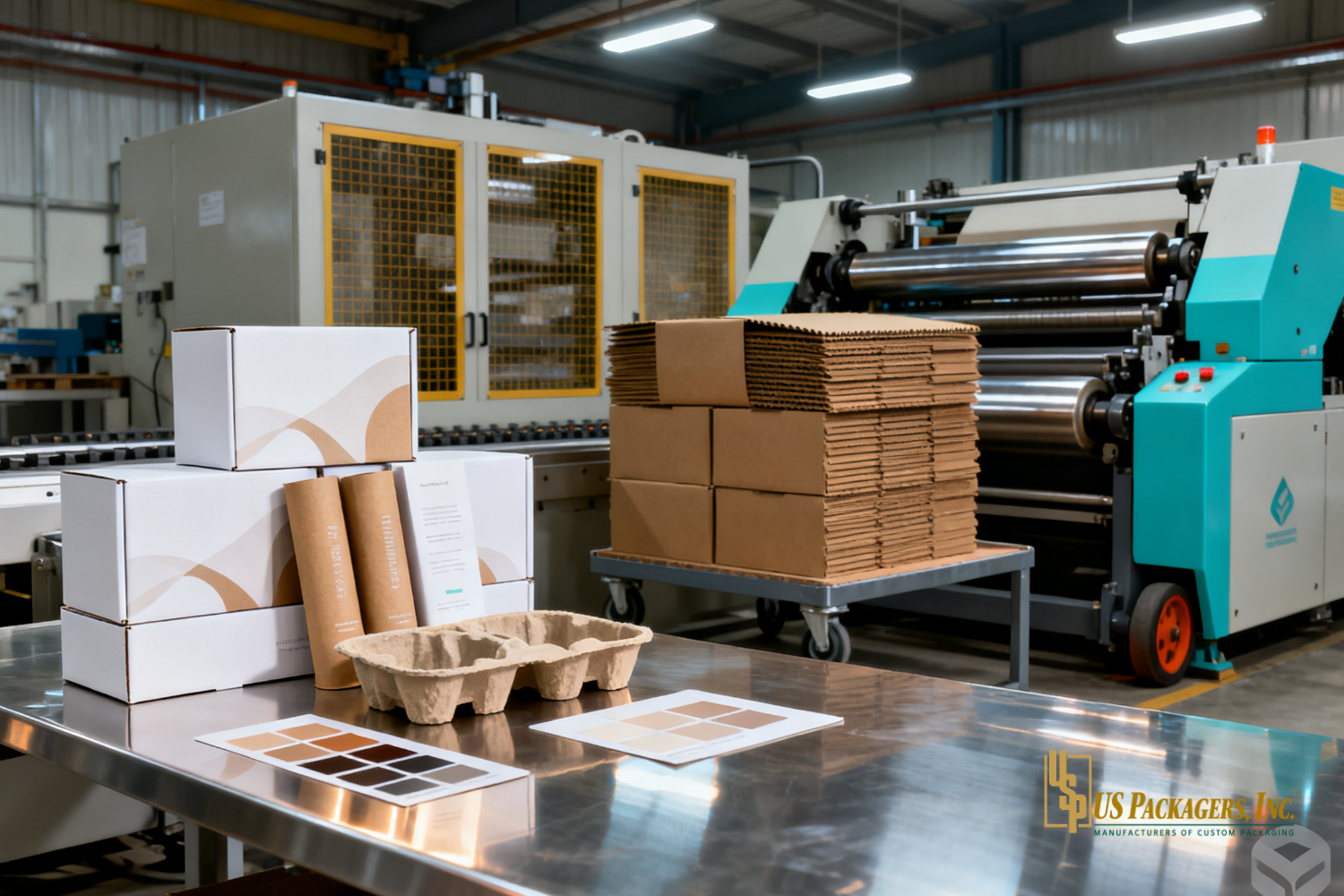
In-House Packaging Manufacturing: Quality, Speed, Cost
Many brands treat packaging as an afterthought until quality issues or shipping damage surface. In-house packaging manufacturing delivers tighter quality control, faster design iterations, and clearer cost visibility for companies producing custom packaging. When evaluating packaging manufacturing options, in-house production reduces handoffs and preserves brand details through every stage of production.
Decisions stall because packaging sits at the intersection of branding, protection, and logistics. Teams must weigh print fidelity against protective structures, balance unboxing experiences with shipping constraints, and synchronize production planning with sales forecasts. These overlapping requirements complicate vendor selection and make it hard to predict lead times, cost per unit, and the right level of customization for a product's lifecycle.
Better decisions start with measurable priorities and close collaboration between design, operations, and marketing. That’s where an integrated approach to in-house design and manufacturing shortens feedback loops and aligns production choices with brand goals. US Packagers follows this approach to support consistent packaging performance while leaving room to adapt as product lines and distribution channels evolve.
Quick Answer
In-house packaging manufacturing provides greater control over quality, faster iteration during design and prototyping, and improved alignment between brand requirements and production constraints. It reduces external coordination, can lower total landed costs at scale for custom packaging, and supports rapid adjustments when products or distribution needs change.
Key Takeaways
- In-house packaging manufacturing improves quality control and protects brand presentation through fewer vendor handoffs.
- Manufacturing flexibility allows faster prototyping and responsive changes to packaging during product development.
- Custom packaging benefits from in-house production when precise print, dieline accuracy, and material selection matter.
- Assess volume, tooling, and fulfillment logistics to decide between stock suppliers and in-house options.
- Work closely with designers, operations, and logistics to balance unboxing experience, protection, and shipping costs.
Quick Business Snapshot
| Category | Details |
|---|---|
| Best For | Brands needing custom packaging with tight quality control |
| Business Size | Small to mid-size brands and growing product lines |
| Primary Benefit | Greater manufacturing flexibility and design-protection alignment |
| Implementation Complexity | Moderate—requires upfront design coordination and production setup |
| US Packagers Service Fit | Packaging Manufacturing and In-House Manufacturing |
| Typical Environment | Onshore production with collaborative design and operations teams |
Who Should Consider This Solution
- Brands that require precise print quality, unique dielines, or special finishes for retail presence.
- Food and beverage producers needing packaging that meets shipping and shelf-life protection goals.
- Health and beauty companies that must control tactile finishes and consistent color reproduction.
- Promotional product companies and entertainment brands that need short runs and frequent design changes.
- Operations teams aiming to reduce vendor complexity and shorten feedback loops between design and production.
Why in-house production improves quality control
In-house packaging manufacturing improves quality control by eliminating many of the coordination gaps that cause defects and misprints. When design, tooling, and production live under the same roof, it becomes easier to validate dielines, preflight art, and material behavior before full runs begin. This reduces surprises for packaging production and keeps brand-critical elements consistent from batch to batch. For products where color matching, embossing, or precision die-cuts matter, direct oversight on the manufacturing floor allows immediate adjustments. That responsiveness shortens the feedback loop between quality inspections and corrective actions, which helps reduce waste and rework costs. For teams balancing retail presentation against protective needs, in-house control means prototypes and functional samples can be produced faster and reviewed in real-world packing and shipping tests. The result is packaging that meets both visual standards and practical performance without long delays caused by distant suppliers.
How manufacturing flexibility affects product launches and seasonal changes
Manufacturing flexibility is a tactical advantage when launch windows are tight or seasonal SKUs vary. In-house capabilities allow smaller minimum runs, staggered production, and quick color or dieline updates, which helps align packaging with marketing calendars. For example, a brand introducing a limited-edition flavor or a holiday gift set needs packaging that reflects the campaign but also protects the product during the busiest shipping periods. With direct access to production, teams can stage runs, implement protective inserts, or add finishing options with fewer logistical delays. That responsiveness also supports iterative testing—A/B packaging tests, shelf impact trials, and fulfillment fit checks can all be run without large upfront commitments to external vendors. The business impact: reduced risk of missed campaigns, lower inventory of obsolete packaging, and better control over the total cost of ownership for custom packaging choices.
Balancing cost, volume, and manufacturing setup
In-house production changes the economics of tooling and per-unit cost. For low volumes, stock solutions or contract printers can be more cost effective, but as customization needs and volumes grow, in-house manufacturing often provides better unit cost control and fewer unplanned expenses. Evaluate the tradeoffs: initial setup for dies, plates, or custom tooling is an investment that pays off over repeat orders and tighter quality control. Work with operations and finance to model total landed cost, including transport, duty, and scrap, not just the printed carton price. Consider also the flexibility value—being able to change artwork or structural design without renegotiating outside contracts has a measurable impact on time to market. This is the point where clear production forecasts, regular design reviews, and coordinated forecasting improve both manufacturing efficiency and the retail readiness of the packaging.
A Practical Example
Situation: a mid-size snack brand plans a regional launch that requires retail-ready cartons and a protective inner tray. Challenge: the initial supplier offered long lead times and limited finish options, putting the launch at risk. Decision: choose an in-house path to produce custom folding cartons and prototyped trays. How US Packagers supports the decision: close collaboration between packaging design and production teams produced functional prototypes for shipping tests, refined print passes for consistent brand color, and adjusted tray dimensions after fulfillment fit trials. The in-house setup allowed smaller initial runs for market testing and fast iterations before scaling. That approach reduced coordination overhead between design and manufacturing and ensured the retail packaging matched shelf expectations while protecting fragile contents.
Design control and prepress considerations
Design and prepress control is where packaging decisions meet manufacturing realities. Accurate dielines, proper bleed and safety areas, and correct use of color profiles all affect the final result. An in-house workflow makes it easier to integrate proofing checkpoints, physical mockups, and press checks into the schedule. By validating substrates, finishes, and adhesives early, production avoids common pitfalls such as ink set issues, improper varnish selection, or structural failures during packing. For brands requiring special inks or tactile finishes, in-house teams can pilot runs to test adhesion and durability. That hands-on prepress validation reduces revisions and ensures that the finished custom packaging aligns with both marketing intent and the constraints of the selected manufacturing processes.
Comparison: Custom Packaging vs Stock Packaging
| Feature | Custom Packaging | Stock Packaging |
|---|---|---|
| Design Flexibility | High - tailored dielines and branding | Low - limited sizes and finishes |
| Lead Time | Moderate - prototyping required | Short - off-the-shelf availability |
| Unit Cost (Low Volume) | Higher per unit | Lower per unit |
| Unit Cost (High Volume) | Competitive after setup | Consistent but limited brand impact |
| Brand Impact | Strong - unique unboxing and shelf presence | Modest - limited differentiation |
Practical Checklist
- Define packaging priorities: protection, branding, shelf impact, and shipping constraints.
- Estimate forecasted volumes and seasonal variability to evaluate tooling investments.
- Create functional prototypes and run ship tests to validate structure and inserts.
- Preflight artwork with manufacturing engineers to confirm dielines, bleeds, and color profiles.
- Compare total landed costs, including transportation, waste, and obsolescence risk.
- Plan staged production: pilot run, market test, then scaled production with quality checkpoints.
- Document handoff processes between design, production, and fulfillment for repeatability.
What US Packagers Recommends
Evaluate packaging choices by starting with the product, target customer, and how the package will be distributed. Prioritize protective requirements and brand visibility before selecting substrates and finishes. For products requiring consistent retail presentation or frequent updates, in-house production offers the flexibility to prototype, adjust, and scale while keeping quality tight. Work with a manufacturing partner that integrates design review, prepress validation, and production oversight to reduce rework and ensure cost transparency. Consider staged rollouts to test market response and refine packaging before committing to large-volume tooling investments.
Common Mistakes to Avoid
- Choosing packaging based only on unit price — include handling, shipping, and waste costs in decisions.
- Skipping prototypes and ship-testing — physical samples reveal fit and protection issues before full runs.
- Underestimating color and finish variability — validate with press proofs and consistent profiles.
- Relying on a single supplier without contingency — plan for alternate runs and spare tooling where possible.
- Failing to align design and operations — regular cross-functional reviews prevent late-stage changes.
Frequently Asked Questions
What is in-house packaging manufacturing and when does it make sense?
In-house packaging manufacturing is producing packaging within the same organization that handles design and production oversight. It makes sense when brand control, rapid iteration, and precise print or structural requirements matter. It suits companies that plan repeatable runs, need close quality checks, or require frequent design adjustments tied to marketing or seasonal launches.
How does in-house production affect lead times and flexibility?
In-house production can shorten iteration cycles for prototypes and small runs because design feedback doesn’t need to travel between multiple vendors. While initial setup for tooling still requires planning, the ability to run pilot batches and adjust specifications quickly improves flexibility for seasonal SKUs or product transitions.
Are there cost advantages to in-house manufacturing?
Cost advantages typically emerge at the point where tooling and repeat orders offset the premium of outsourced short runs. In-house control reduces unexpected rework and shipping-related costs. Calculate total landed cost, factoring in returns, waste, and versioning, to determine whether in-house production yields savings for specific SKUs.
Can small businesses benefit from in-house packaging manufacturing?
Yes. Small businesses benefit when customization, consistent brand presentation, or fast revisions are priorities. In-house options can support smaller pilot runs and controlled brand presentation without the delays and variability found in multi-supplier workflows. Assess volume, forecasting accuracy, and the need for rapid changes to judge fit.
How should teams decide between stock and custom packaging?
Decide based on branding needs, protection requirements, and forecasted volumes. Use stock solutions for simple, low-cost items with stable demand. Choose custom packaging when differentiation, retail presence, or complex protection requirements justify tooling and setup investments. Run a cost-benefit analysis including obsolescence and marketing value.
Making Packaging Part of Product Strategy
Treat packaging as a product decision that affects returns, shelf performance, and customer perception. When manufacturing is integrated with design, physical testing and quality checkpoints become part of development rather than afterthoughts. That alignment reduces surprises in shipping and retail and keeps packaging aligned with evolving product and channel strategies.
Why Trust US Packagers
- Founded in 2012
- 40+ years of packaging industry experience
- In-house design and manufacturing
- Customer-first packaging philosophy
- Custom packaging expertise
- Industries served: promotional products, entertainment, health and beauty, food and beverage
Planning Your Next Packaging Investment
Packaging decisions are most effective when product requirements, brand intent, and logistical realities are considered together. Start by defining protection needs, desired unboxing effects, and distribution constraints, then use prototyping and pilot runs to validate choices. Work with partners that combine design, prepress, and production oversight to reduce risk and keep costs predictable. Explore Packaging Manufacturing Understanding the product, brand, customer experience, shipping requirements, and manufacturing considerations leads to better packaging decisions before choosing a solution.
