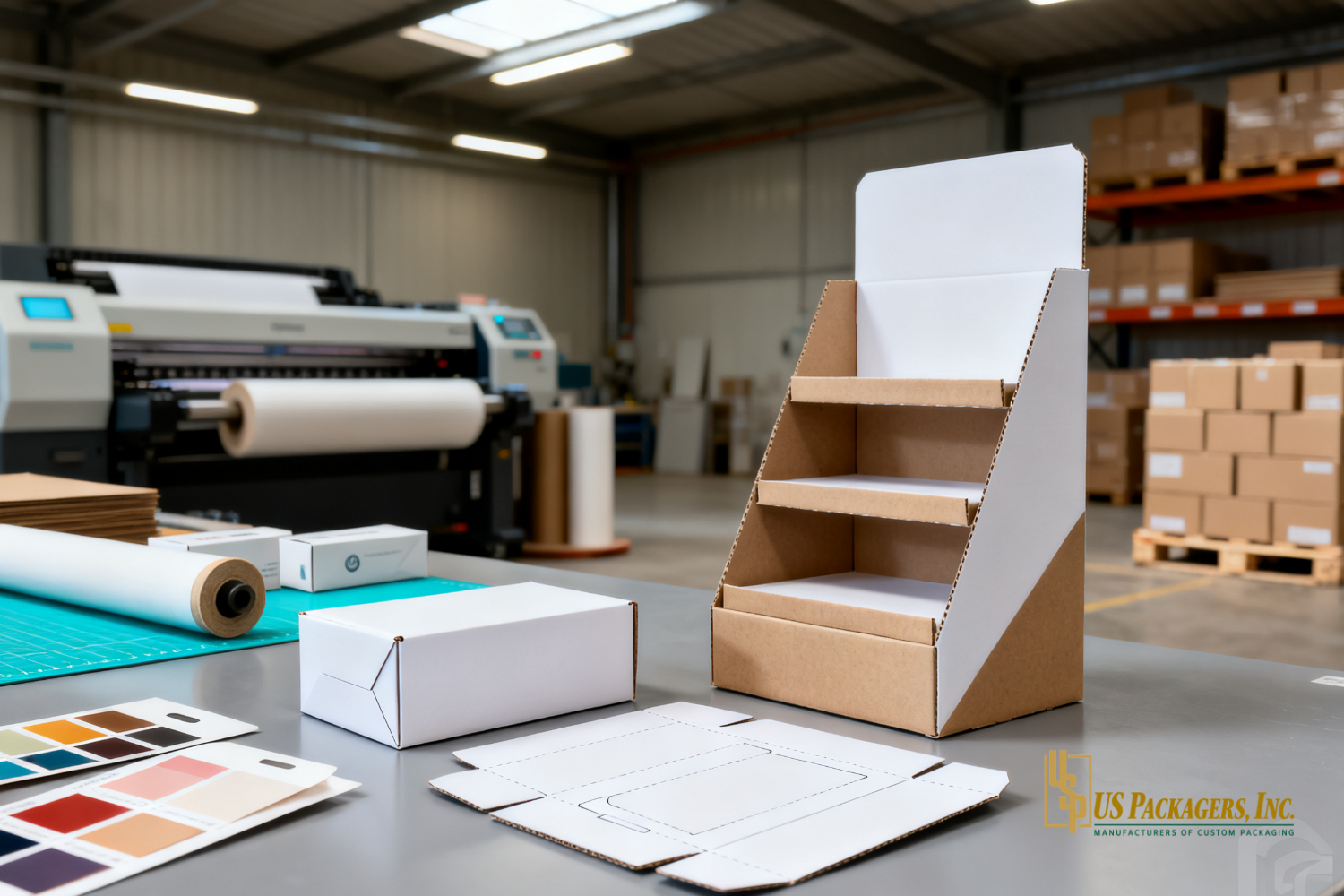
Improve Retail Conversion with Shelf Appeal Packaging
Retail shelves reveal within seconds whether a product connects with shoppers. Packaging improves shelf appeal by combining clear visual hierarchy, distinctive structure, and functional features that invite interaction; this approach—often called shelf appeal packaging—shifts a product from overlooked to noticed. Brands evaluating Retail Packaging should prioritize how design choices perform at eye level and in full display runs.
Many businesses struggle because shelf-focused design must balance branding, product protection, customer experience, shipping efficiency, and production planning. A striking carton that fails in transit or adds excessive fulfillment cost will undercut retail wins. Conversely, over-engineered protection that hides the brand misses retail conversion opportunities.
Practical decisions come from testing tradeoffs between appearance and performance. US Packagers offers in-house design and manufacturing that helps align creative options with production realities and retailer constraints. Treat shelf appeal as a measurable component of product strategy rather than an afterthought.
Quick Answer
Packaging improves shelf appeal by making products easier to spot, easier to understand, and easier to pick up. Effective shelf appeal packaging uses scale, color contrast, typography, structural cues, and placement-ready retail features to increase visibility and conversion without sacrificing protection or supply-chain efficiency.
Key Takeaways
Start with the customer view: prioritize visibility and legibility at arm's length and three to five feet away.
Match structure to retail display: shelf-facing, hang-sell, and pegboard need different engineering solutions.
Use branded packaging elements—color, logo placement, and callouts—to guide attention and convey value quickly.
Balance protection and unboxing with weight, material cost, and shipping constraints to avoid hidden expense.
Prototype and test in real retail fixtures before committing to full production runs.
Quick Business Snapshot
Category | Details |
|---|---|
Best For | Consumer brands seeking improved retail visibility |
Business Size | Small to mid-size brands and growing product lines |
Primary Benefit | Higher shelf conversion through targeted design |
Implementation Complexity | Moderate: design, prototyping, and retailer testing |
US Packagers Service Fit | |
Typical Environment | Mass retail shelves, specialty retail fixtures, and promotional displays |
Who Should Consider This Solution
Brands launching a new product needing standout retail presence.
Health and beauty lines refining shelf branding against competitors.
Food and beverage producers managing fragile items and retail display constraints.
Promotional product companies creating limited-run retail-ready items.
Operations teams reducing returns due to damaged retail merchandise.
Design Decisions That Drive Shelf Appeal
Clear design choices directly increase a product's chance of being noticed. Prioritize a visible focal point—logo, color block, or product window—and concise messaging that communicates the product benefit within one to three seconds. From a business perspective, this reduces the need for broad promotional spend by converting passive shoppers into active consideration.
On the manufacturing side, select printing processes and substrates that preserve color fidelity under store lighting and during transit. Consider spot varnish, tactile finishes, or embossing sparingly: these should reinforce the brand story without adding cost or delaying production. Work with packaging engineers to ensure dielines align with retail facings and that critical art elements remain unobstructed by structural folds or adhesive areas.
Material and Structure Considerations
Choose materials and structures that protect the product while supporting shelf presentation. Lightweight folding cartons work well for most lightweight consumer goods and offer flat-pack efficiency; rigid boxes read premium but increase cost and shipping weight. The right choice balances perceived value with logistical realities.
From a production standpoint, specify board grade, caliper, and finishes early. Shipping tests, drop tests, and shelf mock-ups reveal whether a chosen structure holds up under stacking, merchandising, and consumer handling. For many brands, using a corrugated tray with a printed sleeve delivers protection plus a large visible artwork area without committing to a heavier rigid build.
Color, Typography, and Visual Hierarchy
Strong shelf appeal depends on deliberate visual hierarchy. High-contrast colors and readable typography increase legibility at distance. The brand name and primary benefit should occupy the most visual weight, with secondary product claims clearly smaller but legible.
Designers must account for retail lighting and adjacent competitor palettes. Create a color strategy that performs under fluorescent and LED store lighting, and test typography sizes at three to five feet. Print proofs and mockups help prevent issues like color shift, trapping errors, or type that becomes unreadable when varnished or textured during finishing.
Retail Display and Placement Strategies
Packaging that looks good on a desk may fail on a shelf. Plan packaging specifically for the intended retail placement: shelf-facing lanes, endcaps, pegboards, or counter displays all require different cues and attachment features. Packaging design should include considerations for face-out ratio and how many units are needed to occupy a standard shelf bay.
Collaborate with merchandising teams and retailers early to learn fixture dimensions, required UPC placement, and planogram expectations. Add retail-friendly features such as hang holes, shelf-stable feet, or easy-open mechanics that maintain shelf presence. Use modular packaging that stacks predictably to simplify in-store stocking and improve observed shelf coverage.
Measuring Shelf Performance
Trackable improvements in shelf appeal come from measurable criteria: increased pick-up rate, improved sell-through, or reduced returns. Establish small pilot tests with controlled fixtures to compare variants and supply real sales data before a full rollout.
Combine point-of-sale data, store visits, and mystery-shop feedback to understand how packaging performs across different retailers. Use findings to refine artwork, messaging hierarchy, or structural choices. Measurement helps justify packaging investment and informs whether a premium finish or higher-grade structure delivers enough incremental sales to offset cost.
Custom vs Stock Packaging: A Practical Comparison
Option | When to Use |
|---|---|
Custom Packaging | When shelf differentiation, brand storytelling, or unique product fit are priorities |
Stock Packaging | When speed to market and low volume cost are the primary constraints |
A Practical Example
Here is a concrete scenario: a mid-size beverage brand needs to launch a seasonal flavor in grocery chains and wants strong eye appeal without significant distribution cost increases. The packaging challenge is to create a product-facing display that fits standard shelf depth, resists refrigeration condensation, and showcases flavor cues clearly.
The decision is to use a printed folding carton with a partial die-cut window and a moisture-resistant matte coating. This approach balances visibility and protection while keeping flat-pack shipping efficient. Retail Packaging expertise supports rapid prototyping and in-house adjustments to the dieline, ensuring the final pack performs on the shelf and in store fixtures.
Practical Checklist
Define the primary retail placement and capture fixture dimensions.
Sketch visual hierarchy: logo, primary benefit, and product callout.
Choose substrate and finish based on protection and lighting performance.
Create physical mockups and test in store-like lighting and fixtures.
Run limited pilot SKUs to gather sell-through and handling feedback.
Adjust art, structure, or finishing based on pilot results before scaling.
What US Packagers Recommends
Evaluate shelf appeal packaging by starting with retail context: where a product will sit, how shoppers approach that category, and what competitors are doing. Prioritize legibility and a single compelling value statement, then select materials that protect product during shipping while supporting that visual story. Use in-house design and production to iterate quickly—prototyping reduces risk and uncovers unforeseen production constraints. Plan for scalable SKUs and consider modular packaging that can be adapted across sizes with minimal tooling changes.
Common Mistakes to Avoid
Overcomplicating artwork: reduce clutter to improve legibility at a glance.
Ignoring fixture constraints: always test on the actual shelf or pegboard configuration.
Choosing finishes without testing under store lighting: proofs must simulate retail conditions.
Underestimating protection needs: damaged stock reduces perceived quality and sell-through.
Skipping pilot runs: full production without testing often reveals costly issues.
Frequently Asked Questions
How much does better shelf appeal increase sales?
Improved shelf appeal can increase consideration and conversion, but the precise impact depends on category, price point, and competition. Measure through controlled pilots and compare sell-through rates to baseline listings. Use pilot data to estimate a realistic uplift before budgeting larger packaging investments.
Is custom packaging necessary for small brands?
Custom packaging is not always necessary, but it becomes valuable when distinctiveness on the shelf drives purchase decisions. Smaller brands can start with limited custom elements—like a printed sleeve or custom artwork on a stock carton—then scale to fully custom runs as sales justify the investment.
What finishes improve perceived value on the shelf?
Matte coatings, soft-touch lamination, and selective spot varnish can elevate perceived value without excessive cost. Choose finishes that contrast with neighboring products and test for print fidelity; finishes interact with inks differently and can alter color perception under store lighting.
How should packaging match e-commerce and retail needs?
Design multi-channel packaging by separating exterior retail-facing graphics from inner transit protection. Consider a retail sleeve or display-ready tray that sits inside a stronger shipper when fulfilling online orders. This preserves shelf appeal while ensuring durability in transit.
When should retailers be consulted about packaging?
Engage retailers during concepting to learn fixture sizes, UPC placement, and display rules. Early alignment prevents last-minute redesigns and ensures packaging meets planogram requirements. Retailer input is especially important for endcaps and pallet-ready displays.
Lasting Shelf Appeal Starts with Purposeful Design
Packaging that consistently wins on the shelf combines clear visual priority, fit-for-retail structure, and pragmatic production choices. Treat shelf appeal as a measurable design goal and validate it through prototypes in real fixtures to reduce risk and refine buying signals.
Why Trust US Packagers
Company Snapshot | Details |
|---|---|
Founded | 2012 |
Industry Experience | 40+ years of packaging industry experience |
Capabilities | In-house design and manufacturing |
Philosophy | Customer-first packaging approach |
Expertise | Custom packaging development and production |
Industries Served | Promotional products, entertainment, health and beauty, food and beverage |
Planning Your Next Retail Packaging Investment
Effective packaging decisions begin with a clear understanding of product performance goals and retail context; design, structure, and material choices then align to those goals. Work through prototypes, test in actual fixtures, and refine artwork to balance brand impact with protection and logistics, and consider our Retail Packaging and Custom Packaging capabilities when scaling. Explore Retail Packaging after understanding the product, brand, customer experience, shipping requirements, and manufacturing considerations before choosing a packaging solution.
